Logic, Fallacies & Cognitive Traps
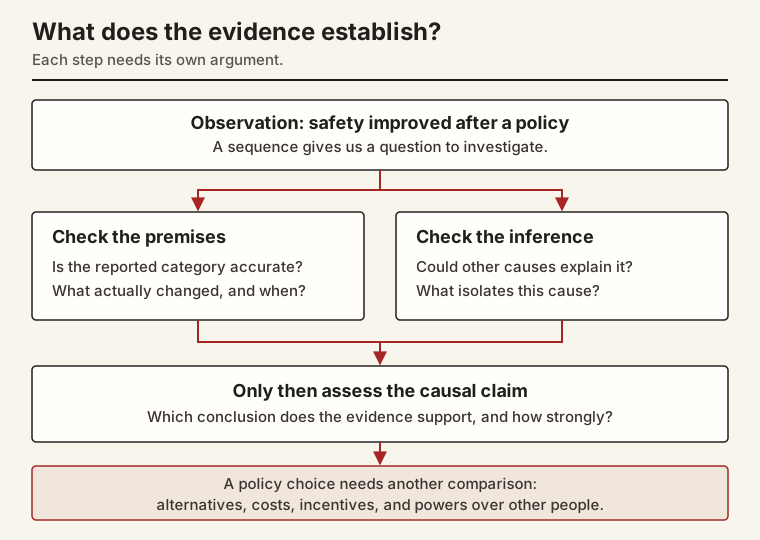
A president takes office, then points to a better airline safety record. What would you need to know before giving him the credit?
In January 2018, Donald Trump wrote:
Since taking office I have been very strict on Commercial Aviation. Good news — it was just reported that there were Zero deaths in 2017, the best and safest year on record!
Even if the figure is right for the flights being counted, we haven't yet shown what his policies had to do with it.
You'd want to know which policies changed and when they could have affected flights. Better maintenance, engineering work, earlier rules, or chance could explain the improvement. What would safety have looked like without his policies? Calling the tweet a lie skips that comparison and blurs the difference between the number and Trump's claim to credit.
What exactly follows?
Start by writing down what the speaker wants you to accept. That's the conclusion. The premises are the reasons offered for it, and the inference is how the argument gets from those reasons to the conclusion. In the aviation example, we have a before-and-after observation followed by a claim about what caused the change.
With deduction, true premises and valid reasoning guarantee the conclusion. Induction uses observations to infer a pattern, though further observations may overturn it. Abduction picks a plausible explanation from incomplete evidence. The last two leave room for doubt: another observation or a better explanation could change your mind.
Validity asks whether a deductive conclusion follows if we accept the premises. Soundness requires true premises too. Suppose every policy this administration introduces improves safety, and it introduced policy A. It follows that A improves safety. The reasoning works; we haven't established the sweeping first premise. With false premises, a valid argument can reach either a true or a false conclusion.
The aviation example risks false cause: assuming causation because two things happened together or in sequence. Other comparisons can mislead too. A confounder affects both variables; with reverse causality, what we called the effect helps produce the supposed cause. We'd have to investigate whether either applies to this safety record.
When the speaker replaces the evidence
When Trump challenged Judge Curiel's rulings in 2016, he turned to the judge's background:
He's a Mexican. We're building a wall between here and Mexico. The answer is, he is giving us very unfair rulings — rulings that people can't even believe.
An ad hominem uses a personal attack to avoid answering an argument. If a judge has a conflict, explain how it bears on the case. His ancestry alone doesn't show that he has one or that he got the ruling wrong.
Discussing climate science in 2018, Trump offered a different reason to trust his judgment:
My uncle was a great professor at MIT for many years, Dr. John Trump. And I didn't talk to him about this particular subject, but I have a natural instinct for science, and I will say that you have scientists on both sides of the picture.
An appeal to authority asks us to treat someone's status as proof. Expertise can give us a good reason to hear someone out. His uncle's job, though, tells us nothing about the evidence for Trump's own view.
Arguing against the right claim
At the 2020 Republican convention, Trump warned about what a Biden victory would bring:
Make no mistake, if you give power to Joe Biden, the radical left will defund police departments all across America. They will pass federal legislation to reduce law enforcement nationwide. They will make every city look like Democrat-run Portland, Oregon.
Biden had already said, "No, I don't support defunding the police." A straw man replaces someone's position with a weaker or more extreme one that's easier to attack. Perhaps the claim is that Biden's allies would override him. That's a prediction about his ability to control his coalition, and it needs evidence of its own.
A steel man is the strongest reasonable version of an opposing argument. Here, that means separating Biden's stated policy from the prediction that coalition pressure would force a different outcome. You have to know which claim you're answering before you can refute it.
The options themselves can get lost in the argument. Discussing deportation in 2015, Trump said:
We will work with them. They have to go. Chuck, we either have a country, or we don't have a country.
A false dilemma presents a choice that leaves out feasible alternatives. A country can choose selective enforcement, legal migration routes, or different eligibility rules. Those policies have costs and consequences to compare. Rejecting one deportation proposal doesn't settle any of them.
In 2017, Bill O'Reilly challenged Trump's view of Putin. Trump answered by shifting attention to Americans:
Bill O'Reilly: "Putin's a killer."
Donald Trump: "There are a lot of killers. We've got a lot of killers. What do you think — our country's so innocent?"
Tu quoque dismisses a criticism by accusing the critic of hypocrisy. Whataboutism shifts the discussion to someone else's offense. American wrongdoing could expose a double standard without disproving O'Reilly's allegation. There could also be a separate case for cooperation with Putin, but that would need an argument about its likely costs and benefits.
Compare these two descriptions of an immigration restriction. Trump's December 2015 proposal stated:
Donald J. Trump is calling for a total and complete shutdown of Muslims entering the United States until our country's representatives can figure out what is going on.
In January 2017, he defended the executive order in different terms:
To be clear, this is not a Muslim ban, as the media is falsely reporting. This is not about religion – this is about terror and keeping our country safe.
With motte-and-bailey, a speaker retreats from a controversial claim to an easier one when challenged, then uses that defense to repeat the original claim. The two restrictions here need different arguments. Look for the speaker moving between them as though they were interchangeable; a revised policy alone isn't enough.
What would show the claim is wrong?
Discussing the removal of Confederate statues in August 2017, Trump predicted where it might lead:
This week it's Robert E. Lee. I noticed that Stonewall Jackson is coming down. I wonder, is it George Washington next week? And is it Thomas Jefferson the week after? You know, you really do have to ask yourself, where does it stop?
A slippery slope claims that one step will lead to others without showing why each follows. What rule would carry the decision from Lee to Washington? Could people draw a distinction and stop there? A shared criterion might support the prediction, but the argument has to supply it.
Sometimes an argument rules out contrary evidence before anyone can examine it. In February 2017, Trump wrote:
Any negative polls are fake news, just like the CNN, ABC, NBC polls in the election.
Under that rule, a poll becomes acceptable only when it gives the desired answer. Circular reasoning assumes the conclusion it's supposed to prove. A poll may have a bad sample or a poorly worded question, but you have to identify that fault separately from whether you like its result.
Why weak arguments persuade
Aristotle distinguished logos, persuasion through reasons; ethos, through credibility; and pathos, through emotion. Credibility helps us decide whom to hear out, and emotion gives us reasons to care. An appeal to emotion occurs when the feeling takes the place of evidence.
Trump's 2015 campaign announcement associated Mexican immigration with crime:
When Mexico sends its people, they're not sending their best... They're bringing drugs. They're bringing crime. They're rapists. And some, I assume, are good people.
Fear gives people a reason to pay attention. It tells us little about how common a crime is, which populations we should compare, or whether a particular restriction would make anyone safer. Answering those questions takes more than a frightening description.
Few of us have time to investigate every claim we encounter. Bounded rationality means making decisions with limited time, attention, and information, so relying on someone competent is often sensible. Just remember how much you're taking on trust. And spotting bad reasoning doesn't finish the job either: the fallacy fallacy is declaring a conclusion false because one argument for it fails.
A Gish gallop overwhelms an opponent with weak claims arriving faster than they can be checked. In Trump's September 29, 2020 debate with Biden, allegations and interruptions repeatedly got in the way of answers. That makes checking difficult, though an interruption alone tells us little about a claim's truth or a speaker's intent. Pick a claim that matters and follow it through before chasing the next one.
Apply the test to your own side
It's easiest to demand evidence when you dislike the person speaking. Motivated reasoning starts with the conclusion you want and works toward it. You might demand more evidence from opponents than allies (asymmetric skepticism), change the test after someone meets it (goalpost-moving), or answer an easier question, such as whether you trust the speaker (attribute substitution). These habits deserve attention when Trump says something you agree with, too.
Suppose an established AI company proposes mandatory licenses after a data leak. You can accept that the leak happened and still ask why licensing would prevent the next one. Would liability, independent testing, or letting users choose another service address the problem? What would a licensing office cost, and what could it forbid?
Equivocation uses the same word with different meanings inside an argument. Here, "safe" may quietly become "officially approved." What does approval actually check? Expensive requirements can protect established firms from new competitors, and officials may depend on those same firms for information. The agency would need ways to check what firms tell it and correct its own mistakes, including mistakes that benefit those firms.
Who benefits if the rule passes? The answer may help you spot an assumption its supporters have left unspoken. It doesn't, by itself, prove them wrong. Give an expert's promise to manage other people's choices the same scrutiny you'd give a politician's claim to credit.
Write down the claim and its reasons, then ask what evidence could make you reconsider. When someone proposes a remedy, follow the argument that extra step: how would it help, who would gain power, and what would happen to the people whose choices it restricts?