Price Controls, Externalities & the Limits of Markets
10.1 Price Ceilings and Floors
When governments want to protect consumers from rising costs or shield producers from falling revenues, they often reach for price controls. These interventions are politically popular, but they disrupt the price system's coordinating function and turn price signals into administrative bottlenecks.
A price ceiling is a legal maximum price for a good or service. If the government sets it below the market-clearing equilibrium (), a chronic shortage follows. At this artificially low price, the quantity demanded exceeds the quantity supplied (). Because the price can no longer rise to ration the scarce good, other mechanisms take its place: queues, favoritism, declining quality, and black markets where buyers and sellers trade illicitly at the price the market would have set anyway.
The European Union's energy price caps during the 2022–2023 gas crisis show how this plays out. As wholesale gas prices surged, several European countries capped retail electricity and gas prices to protect households. The caps shielded consumers in the short term, but they put supply at risk. To prevent utility bankruptcies and blackouts, governments had to cover the gap with large subsidies. The caps did not make the high cost disappear; they shifted it onto taxpayers.
Argentina's deregulation under President Javier Milei in 2024 ran the experiment in the other direction. Buenos Aires had long enforced strict rent control that capped increases and dictated contract terms. Landlords pulled their properties off the market, and a severe housing shortage followed. After the controls were repealed, the supply of listed rentals rose by more than 170% within months. Nominal prices adjusted, but real, inflation-adjusted rents fell sharply as competition returned. Removing the control dissolved the scarcity it had created.
A price floor is a legal minimum price; agricultural price supports and minimum wage laws are examples. If the floor sits above the equilibrium price (), the quantity supplied exceeds the quantity demanded (), and a persistent surplus results. In agriculture, that surplus usually forces the government to buy and store the excess crop at taxpayer expense. In labor markets, a binding minimum wage can price lower-skilled workers out of jobs.
10.2 Deadweight Loss: The Cost of Market Distortions
The main cost of a price control is the mutually beneficial transactions it prevents. Economists measure that lost welfare as deadweight loss (DWL): the net loss in social surplus a distortion causes.
To formalize this, take total economic surplus (), the sum of consumer surplus () and producer surplus (). Consumer surplus is the gap between what buyers would pay and the market price; producer surplus is the gap between the market price and sellers' marginal cost:
In an undistorted market, exchange proceeds until the marginal buyer's valuation equals the marginal seller's cost at the equilibrium quantity . This maximizes total surplus:
When a price ceiling restricts the quantity traded to , the transactions between and never happen. The deadweight loss is the unrealized gains from those forgone trades:
This value is not transferred to consumers or producers. It simply disappears.
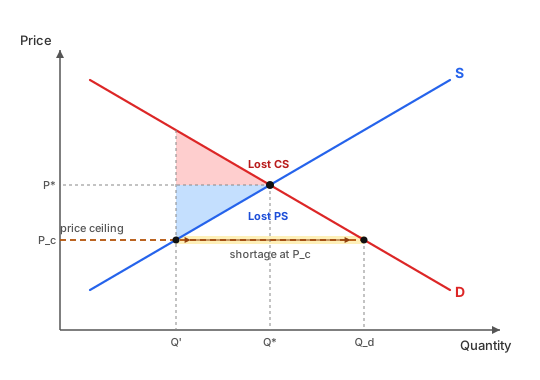
The geometry of the triangle shows that the welfare cost of a price control rises quadratically with the size of the distortion. As the gap between the controlled price and equilibrium widens, quantity contracts further and the triangle of lost welfare grows fast.
10.3 Externalities: The Divergence of Private and Social Costs
The price system reaches efficiency by lining up private incentives with social welfare. That alignment breaks down when an activity imposes costs or benefits on third parties who are not part of the transaction. These spillovers are called externalities.
An externality is a divergence between private cost and social cost. Let be the private marginal cost of production and the marginal external cost imposed on society, such as pollution or resource depletion. The social marginal cost () is the sum of these two components:
Similarly, if an activity generates positive spillover benefits, the social marginal benefit () is the sum of the private marginal benefit () and the marginal external benefit ():
In a competitive market without government intervention, private actors set their private marginal benefit equal to their private marginal cost (), which gives the market quantity . Social efficiency instead requires social marginal benefit to equal social marginal cost (), which gives the socially optimal quantity .
When a negative externality exists (), the social marginal cost exceeds the private marginal cost. Because private firms ignore the external cost, they overproduce: . This overproduction creates a deadweight loss, as the social cost of the marginal units exceeds their social benefit.
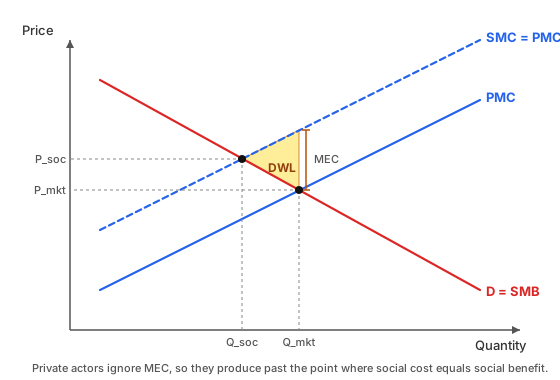
The standard market-failure argument runs like this: because property rights are ill-defined for shared resources like the atmosphere or rivers, markets fail to price them. Polluters then treat these assets as free dumps, so some institutional corrective is needed to internalize the cost.
10.4 The Coase Theorem and Transaction Costs
In his 1960 paper The Problem of Social Cost, Ronald Coase challenged the prevailing view that externalities require immediate government intervention. Coase formulated what has become known as the Coase Theorem: if property rights are clearly defined and transaction costs are zero, private parties will bargain to reach the socially efficient outcome, regardless of the initial allocation of property rights.
Consider a chemical plant upstream from a commercial fishery. The plant's runoff damages the fish stock, a negative externality. Suppose the socially optimal level of production balances the plant's profits against the damage to the fishery.
If the law grants the chemical plant the right to pollute, the fishery can offer a payment to the plant to reduce its output. The fishery is willing to pay up to the value of the avoided damage, and the plant is willing to accept any payment that exceeds its marginal profit from the forgone production. Bargaining will continue until the plant's marginal profit equals the fishery's marginal damage, which is the socially efficient outcome.
Alternatively, if the law grants the fishery the right to clean water, the chemical plant can pay the fishery for permission to discharge a specific amount of runoff. The plant is willing to pay up to its marginal profit, and the fishery is willing to accept any payment that exceeds its marginal damage. Once again, bargaining leads to the exact same efficient level of pollution. The initial allocation of property rights determines who pays whom, but does not alter the efficiency of the final resource allocation.
The real payoff of Coase's analysis is its converse. Transaction costs, including search and information costs, bargaining costs, and the expense of enforcing contracts, are rarely zero. In the real world, these costs are often prohibitively high, particularly when an externality affects thousands of dispersed individuals, such as air pollution in a major city.
When transaction costs prevent private bargaining, the initial assignment of property rights and the structure of legal institutions determine the efficiency of the economic outcome. As legal scholar Katharina Pistor observes in The Code of Capital, the legal codification of rights determines who holds the legal advantage and who must bear the burden of transaction costs. In a world of high transaction costs, institutional design is what decides whether resources are allocated efficiently or wastefully.
10.5 Pigouvian Solutions vs. Cap-and-Trade
When transaction costs rule out private bargaining, governments have to pick a regulatory tool to correct the externality. The two main approaches are Pigouvian taxes and cap-and-trade systems.
A Pigouvian tax internalizes a negative externality by imposing a tax on the polluting activity equal to the marginal external cost at the socially optimal quantity (). This tax shifts the private marginal cost curve up until it matches the social marginal cost curve (). Facing the tax, firms cut output to the socially optimal level . The tax also raises revenue while correcting the distortion.
A cap-and-trade system achieves the same outcome through quantity restrictions rather than price manipulation. The regulator establishes a maximum legal limit on the total quantity of pollution () and issues a corresponding number of tradable pollution permits. Firms that can reduce emissions cheaply sell their excess permits to firms facing higher abatement costs. An open market for permits emerges, and the permit price () adjusts to reflect the marginal cost of abatement.
The choice between these two instruments hinges on their differing information requirements and political vulnerabilities.
To set an optimal Pigouvian tax, the regulator must know the private abatement costs and the marginal social damage curves precisely. If the regulator sets the tax too low, pollution remains excessive; if set too high, the economic cost of over-regulation exceeds the social benefit.
In contrast, a cap-and-trade system allows the regulator to target the desired ecological outcome directly by setting the cap, leaving the market to discover the efficient price of pollution. But cap-and-trade needs strong monitoring to prevent cheating, and the permit price can swing enough to make long-term investment risky.
The European Union Emissions Trading System (ETS) is the largest application of Coasean logic in practice. It caps carbon dioxide emissions from power stations and industrial plants and lets firms trade emission allowances. In the 2020s the carbon price rose past €90 per tonne. That signal pushed utilities away from coal toward natural gas and renewables. A well-built carbon market can internalize a global externality, but only with the monitoring and enforcement to back it up.