Price as Information, Opportunity Cost & Spontaneous Order
8.1 The Coordination Marvel
In his 1958 essay I, Pencil, Leonard Read pointed out something odd: no single person on earth knows how to make a pencil. It takes graphite from Sri Lanka, cedar from Oregon, rubber from Indonesia, and lacquer from chemical plants that depend on countless other inputs. The supply chain connects millions of strangers who will never meet, and the finished pencil costs pocket change. All of it is coordinated by the price system, with no one in charge. How that works is the subject of this chapter.
8.2 Supply, Demand, and the Margin
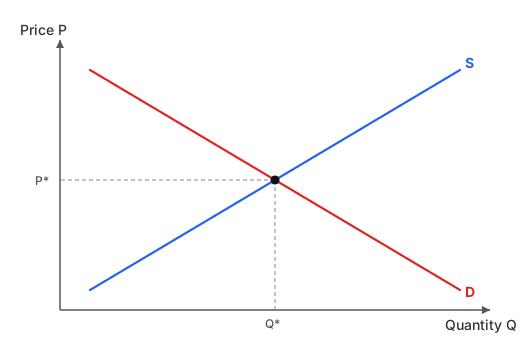
A demand curve gives the quantity buyers want at each price; it slopes downward. A supply curve gives the quantity sellers will offer; it slopes upward. The equilibrium price is where . At any other price there is a shortage or a surplus, and the price adjusts. A price is not a static snapshot; it moves, and the movement is the work it does.
That equilibrium is not a resting point. It is the running total of thousands of individual decisions made at the margin, which brings in the second core concept: marginal analysis. Most real choices are incremental rather than all-or-nothing. The question is whether to consume or produce one more unit. The relevant comparison always weighs marginal benefit (MB) against marginal cost (MC). We opt to consume or produce the next unit if MB > MC, and stop precisely when MB = MC. Most policy debates that appear to be disputes over whether a program is "worth it" in its entirety actually center on where this margin should sit.
8.3 Prices as Information
Friedrich Hayek's 1945 essay The Use of Knowledge in Society explained what the price system is actually for. While standard models treat the economic problem as the mechanical allocation of known resources to known ends, which is a task any sufficiently powerful computer could solve, the real challenge lies in coordinating knowledge dispersed across millions of individuals in fragments none of them can fully articulate. The bakery foreman knows which oven runs hot; the shopkeeper knows which brand sells in their neighborhood; the mining engineer knows from the texture of the rock whether a seam is worth following. This knowledge is local, tacit, and often unconscious. It cannot be cataloged, digitized, and shipped up a bureaucratic chain.
The price system bypasses this bottleneck. A tin mine collapses somewhere in Bolivia. Almost no one in the world knows what happened. But the price of tin rises worldwide, and every user of tin (such as the packaging plant in Saxony, the electronics assembler in Shenzhen, or the plumber in Lagos) economizes, substitutes, or pays more if their use is high-value. They do this without knowing why the price rose. They do not need to know. The price has compressed dispersed knowledge into a clear signal each of them can act on.
Central planners cannot, even in principle, replicate this. Ludwig von Mises had made the related point in 1920: without market prices for capital goods, you cannot rationally calculate whether steel or aluminum is the better material for a bridge. The Soviet planners did not fail for lack of intelligence or effort. Their task could not be done at all. Gosplan was still issuing five-year plans for an economy whose actual operation it had stopped understanding decades earlier. The collapse was a forecast, not a surprise.
The argument extends beyond allocation. Entrepreneurship is the discovery of information that does not yet exist: a new combination of inputs people will pay for, or a cheaper way to make something that already exists. Discovery cannot be planned because no one knows in advance what is to be discovered. Markets, with their continuous trial and error and their broadcast feedback through profit and loss, are a discovery procedure. Removing this procedure does not merely reduce efficiency; it destroys the mechanism by which the economy learns.
8.4 Bastiat's Broken Window and Opportunity Cost
In 1850, Frédéric Bastiat asked his readers to consider a shopkeeper whose careless son has broken a window. The crowd consoles him: the glazier will be paid six francs, the glazier will spend his earnings, the economy will turn. By this logic, the broken window is stimulus.
Bastiat's reply is the essay's title, Ce qu'on voit et ce qu'on ne voit pas: "what is seen and what is unseen." Yes, the glazier earns six francs. But the shopkeeper, had the window not been broken, would have spent those six francs on shoes or books. The shoemaker does not appear in the story precisely because the transaction never occurred. The economy has the same window and is missing the shoes.
The general principle is opportunity cost: the value of the next-best alternative forgone. The real cost of a public works project, rather than the nominal cash outlay, consists of whatever those same resources would have produced in their next-best use. The cost of a new highway bypass is the local clinics and research grants that were never funded because the bypass was. There is no free lunch.
The political problem is that opportunity cost is invisible. The highway bypass is visible; the unbuilt local clinics are not. The factory the tariff protects is visible; the unfounded startup that would have employed the next generation is not. Political incentives systematically favor projects with concentrated, visible benefits over projects with diffuse, invisible costs. Most stimulus rhetoric collapses under this lens, and that is exactly what makes the lens valuable.
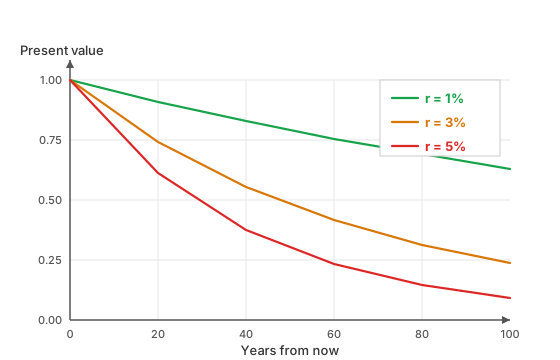
Opportunity cost runs through time as well. A discount rate translates future value into present terms, and political time horizons are far shorter than any defensible moral rate. A politician facing reelection in four years has every incentive to defer costs to a successor. This intergenerational overdraft is not a reformable quirk; it is the default condition of democratic decision-making about anything with a long horizon.
8.5 Tax Incidence: Who Really Pays
Consider a $0.20 tax per liter of fuel, collected from the seller at the pump. Who actually bears the economic burden? The answer follows from elasticity. If buyers are highly inelastic, perhaps because they have no public transit alternatives, the seller raises the retail price by nearly the full $0.20, and buyers swallow the cost. If buyers are elastic, with easy access to trains or electric vehicles, the seller must absorb most of the tax through lower margins to keep demand from cratering. The party with the worse outside option pays, regardless of whom the legislature designates as the legal taxpayer.
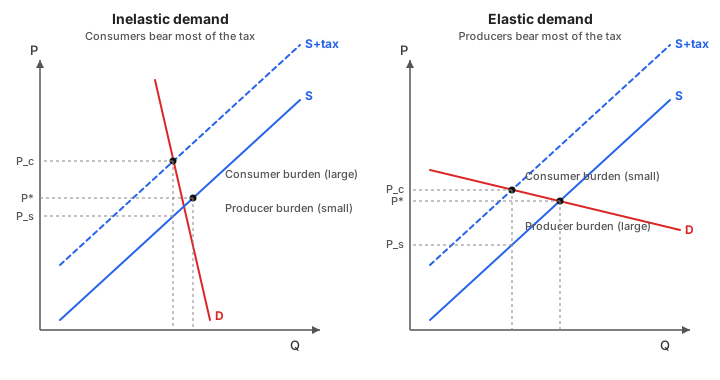
A "tax on corporations" sounds painless because the legal taxpayer is an abstraction. In reality, corporations are legal arrangements among shareholders, workers, customers, and suppliers. Any cost must ultimately land on whichever of those groups is most inelastic. In an open economy with mobile capital, that is usually workers. Most political rhetoric about who pays a tax is innocent of the economics, and the innocence is rarely an accident.
8.6 Spontaneous Order and Synthesis
Spontaneous order is real. Languages were not designed by committee. Common law accreted from case to case. Markets coordinate without anyone in charge. The order arises from human action but not from human design. This is the central insight of modern social science. Complex coordination is possible with no intelligence directing it, which cuts against the constructivist instinct that any social pattern must have been planned by someone.
The price system is the most powerful instance of this. It compresses dispersed information into actionable signals. It allocates scarce resources to high-value uses without anyone in charge. It rewards discovery and punishes error. The historical record on attempts to override it at scale is unambiguous: command economies collapsed, price controls produce shortages and black markets, planners who second-guess prices reliably destroy wealth. The economies that grew fastest in the last half-century, including postwar West Germany, the Asian tigers, post-1978 China, and post-1991 India, all did so by freeing prices and protecting the institutions that let entrepreneurs profit from being right.
Three quick contemporary tests. Uber surge pricing raises fares when demand spikes; more drivers log on, marginal riders take the bus, the market clears in real time at a scale no planner could have managed. The cities that capped surge ended up with shortages exactly when riders needed rides most. China's post-2008 stimulus poured roughly 4 trillion yuan into infrastructure and real estate that the price system would never have funded; the visible result was GDP growth, the unseen result was ghost cities, unsold inventory, and a local-government debt overhang the country is still working through.
The case for markets is not that they are sacred. It is that they work, better than anything else anyone has tried. The burden of proof for overriding them should stay high, because every serious attempt to do so at scale has produced outcomes far worse than the system it replaced. The next chapter examines the institutional foundation that makes markets possible — property rights, transaction costs, and the creative destruction that drives long-run growth. Chapter 10 then takes up the genuinely harder cases, such as price controls, externalities, and bargaining, where the market mechanism does sometimes require assistance.