The Knowledge Problem & Model Uncertainty
7.1 The Fund That Knew Everything
In 1994, Nobel laureates Myron Scholes and Robert Merton co-founded Long-Term Capital Management, a hedge fund using the most advanced mathematical models in finance. By 1998, LTCM had leveraged $4.7 billion into over $1 trillion in positions, calibrated on the assumption that bond spreads would converge to historical norms.
In August 1998, Russia defaulted on its debt — an event the models treated as virtually impossible. Spreads diverged wildly. LTCM collapsed in weeks, requiring a $3.6 billion Federal Reserve bailout to prevent a global financial chain reaction.
The models assumed the future would mirror the past. This chapter is about that kind of failure: what can any decision-maker actually know about a complex system, and what happens when the model itself is wrong?
7.2 Tacit Knowledge and the Price System
A Soviet planner setting the price of bread needs to know the cost of wheat, conditions at thousands of bakeries, preferences of millions of consumers, and how all of these shift with weather and tastes. This information never exists in one place. Much of it is tacit — the factory foreman who knows which machine overheats on humid days, the shopkeeper who knows what sells in this neighborhood. It cannot be easily articulated, let alone transmitted up a bureaucratic chain.
Friedrich Hayek (1945) showed that the price system bypasses this bottleneck. When a tin mine collapses in Bolivia, the price of tin rises worldwide. Every tin user economizes and substitutes — without knowing why. Prices distill dispersed local knowledge into signals that coordinate behavior automatically. Competition reinforces this: entrepreneurs try things, most fail, some succeed, and prices broadcast the results. Central planning suppresses the entire discovery process.
Soviet-style command economies collapsed because the task was impossible from the start. But Hayek's insight was weaponized during the Cold War to argue against any collective planning — public healthcare, industrial policy, environmental regulation. That conclusion stretches far past what the evidence supports.
7.3 The Market That Didn't Build Itself
Karl Polanyi made the complementary observation. The self-regulating market is a political construction. The English labor market was created by the Poor Law reforms of 1834, which deliberately destroyed the safety net so rural workers had no choice but to accept wage labor. Every functioning market has required enclosure acts, legal frameworks, and continuous state enforcement.
The synthesis: Hayek is right that prices coordinate activity better than any planner could. Polanyi is right that the market where those prices operate is shaped by power and sustained by state infrastructure. Which decisions to centralize and which to decentralize is an empirical question, not an ideological one.
7.4 What the State Can and Cannot Do
What it cannot do well: centrally price consumer goods, allocate resources across millions of competing uses, or replicate decentralized discovery. Mises showed that without private capital markets, you cannot calculate whether steel or titanium is more efficient for a bridge. Hayek went deeper: the problem is discovering information that does not yet exist. Entrepreneurial discovery cannot be centralized.
What it can do: fund foundational research, absorb risks private capital won't touch, build infrastructure on which private innovation builds. The internet (DARPA), GPS (DoD), touchscreens (CIA), lithium-ion batteries (DoE) — all involved long-horizon, high-risk research no private firm would have undertaken. South Korea directed credit to targeted industries and produced an economic miracle. India's UPI was centrally designed but deliberately decentralized in operation.
The pattern: centrally design the infrastructure and conditions for decentralized activity; do not centrally plan the activity itself.
7.5 Model Uncertainty and Fat Tails
LTCM illustrates a problem that applies to any model-based decision — in finance, public health, climate science, or AI governance.
Standard risk models assume a Gaussian (normal) distribution, where extreme events are vanishingly rare. Many real-world phenomena follow fat-tailed distributions, where catastrophic events are far more common than the bell curve predicts. Financial returns, earthquake magnitudes, pandemic sizes — all fat-tailed. A model calibrated on normal times will systematically underestimate disaster.
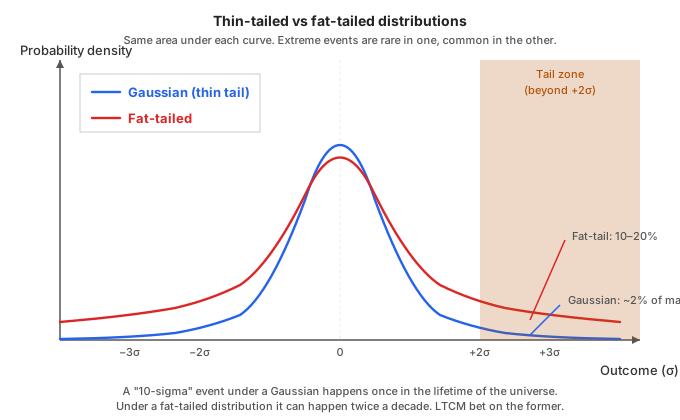
Nassim Taleb's framework:
- Black Swan: An event that was unprecedented, carries extreme impact, and is rationalized after the fact as predictable (2008 crisis, 9/11, the internet).
- Ludic fallacy: Confusing the model with reality. Casino math works because rules are fixed and tails are thin. The real world has shifting rules, unknown probabilities, and fat tails.
- Antifragility: Since prediction fails, design systems that gain from disorder — limited downside, unlimited upside. Decentralized systems with many small independent units fail better: damage stays local instead of cascading.
7.6 The New Knowledge Problem: Platforms
The Cold War framed the knowledge problem as state versus market. Today the most powerful information aggregators are neither.
Google, Meta, and ByteDance collect behavioral data at a scale no central planner ever approached — and they actively shape the behavior they observe through recommendation algorithms and targeted advertising. They aggregate knowledge about people rather than from people. Information flows upward (users reveal preferences through clicks); control flows downward (algorithms shape what users see).
Shoshana Zuboff calls this surveillance capitalism: private entities accumulating population-level behavioral data and using it to modify human action rather than to allocate resources. The user is raw material, not customer. The traditional state-versus-market debate fails to describe a world where the dominant actors are supranational data empires.
7.7 Models Meet Reality: Three Cases
The Great Leap Forward (1958–1962). Mao mandated absurd grain production targets and ordered peasants to melt farming tools in backyard steel furnaces. Local officials, terrified of falling short, wildly exaggerated crop yields. The central government exported grain based on fictional surpluses while villages starved. Tens of millions died — the ultimate case of top-down planning destroying the local feedback mechanisms it needed to function.
Scientific Forestry in 18th-Century Prussia. The state replaced diverse natural forests with ordered rows of identical Norway spruce to maximize timber yields. For one generation, profits soared. Then, without the ecosystem of insects, birds, and varied plant life to maintain soil health, subsequent generations of trees stunted and died. James C. Scott's classic example of a state simplifying a complex system to make it legible, and destroying the thing it was trying to control.
The 2008 Financial Crisis. Global banks used quantitative models assuming housing prices across U.S. regions were largely independent — making a nationwide crash near-impossible by the math. The models ignored the reality of predatory lending on the ground. When mortgages failed simultaneously, the models broke down and triggered a chain reaction that nearly destroyed the global economy.
7.8 The Pretense of Knowledge
In his 1974 Nobel lecture, Hayek warned against the "pretense of knowledge" — the belief that because the natural sciences succeed by measuring and modeling, the same approach will work for complex social systems. Economists and policymakers frequently imitate physics: they build a model, calibrate it on historical data, and optimize for a target variable.
As we saw with Goodhart's Law (Chapter 4), this immediately triggers a trap: the target variable responds to being targeted. The Great Leap Forward was simply this dynamic playing out at a civilizational scale. Because grain output became the sole metric of political loyalty, local officials fabricated the numbers. The state then optimized its policies based entirely on that fiction, while millions of people starved in reality.
James C. Scott calls the underlying impulse legibility — the state's desire to make a messy, organic system clean enough to measure and control. Legibility is not inherently destructive; census data, property registries, and standardized weights and measures are preconditions for functioning governance. It becomes destructive when the simplified map replaces the territory — when the Prussian state treats a forest as nothing but rows of lumber, or when a financial regulator treats the economy as nothing but the variables in the model.
The pattern across every case in this chapter is the same: a decision-maker substitutes a simplified representation for a complex reality, optimizes for what the representation can see, and is blindsided by what it cannot. The antidote is not to abandon models — all thinking is modeling — but to maintain what the models leave out as a permanent, explicit source of uncertainty. Epistemic humility is not modesty.